How to memorize Japanese vocabulary with picture mnemonics
Most Japanese words sound nothing like English ones, so your memory has nothing to attach them to. Picture mnemonics give it something.
Why Japanese words don't stick
When an English speaker learns Spanish, many words come with a head start: hospital, animal, chocolate. Japanese has far fewer of these outside recent loanwords. ねこ (neko) for "cat" or いぬ (inu) for "dog" have no English hook, so flashcard repetition has to do all the work.
Repetition works, but slowly. Memory researchers have long found that people recall concrete images better than abstract words, and that linking a new word to a vivid picture helps it come back later. The best-known technique built on this is the keyword method, first studied for language learning in the 1970s.
The keyword method in one paragraph
Take the foreign word, find an English word that sounds like part of it (the keyword), and imagine a scene that joins the keyword to the meaning. To remember the word later, you hear the sound, recall the keyword, see the scene, and read off the meaning.
The problem with making up keywords
Making up a fresh keyword for every word is hard work, and it gets harder as the words get longer. You also end up with hundreds of unrelated images, and nothing you learned for one word helps with the next.
A picture for every sound
Remlori fixes this by giving each Japanese sound one permanent picture, then building every word from those pictures. Japanese is well suited to this: words are made from a small set of syllables, each written as one hiragana character. Learn 104 sound pictures and you can picture any word in the course.
Here is ねこ (neko, cat):
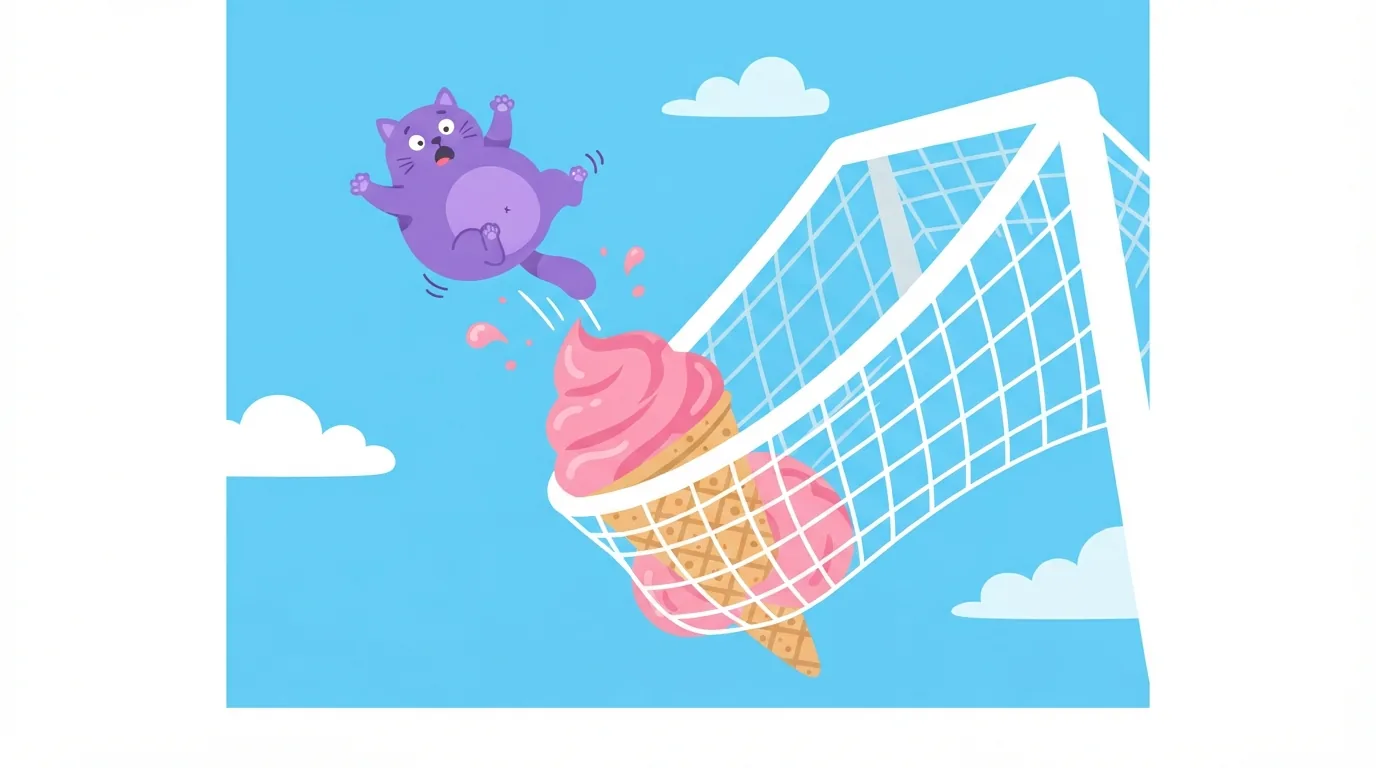
The net and the cone are the sounds; the cat is the meaning. Picture the scene and "neko" comes back with it.
It gets easier as you go
Because the sound pictures repeat, each new word is mostly made of pictures you already know. A few more from the first chapter:
たこ (tako) = octopus: た (ta) → Taco + こ (ko) → Cone
Balancing a crunchy Taco in one arm and a pink ice cream Cone in the other, a purple Octopus stretches its tongue right across to lick the ice cream.
すし (sushi) = sushi: す (su) → Soup + し (shi) → She
Steaming Soup splashes a dancing woman as She spins and lands face-first into a giant roll of Sushi.
With practice you stop needing the picture: you hear ね and know it.
Tips for making it work
- See the scene, don't just read it. Take two seconds to picture it in color. Odd or funny scenes stick better than ordinary ones.
- Say the word out loud. Hearing the Japanese audio alongside the picture keeps your accent tied to the audio, not to the English keyword.
- Test yourself from the Japanese side. Hear the word, rebuild the picture, get the meaning. That is the direction you'll need in conversation.
- Use the words in sentences soon. A mnemonic gets a word into memory; using it is what makes it automatic.
Try it
Browse the hiragana chart to see every sound picture, or look through the first 93 words.
Chapter 1 is free: learn the sound pictures, then the words.
Start Chapter 1 free